Artificial intelligence is taking the world by storm. AI, as it is commonly called, is having an impact on everything from business to healthcare to education.
Hawaii educators committed to staying at the forefront of generative technology gathered for the Hawaii Education Association’s annual Leadership Summit and Education Workshop at Blaisdell Center Pikake Room in Honolulu on December 8 and 9, 2023, to know how to integrate this new technology and establish appropriate safeguards for their schools and classrooms.
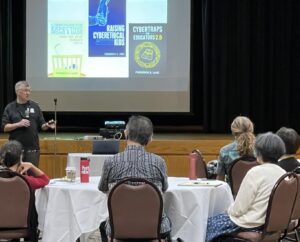
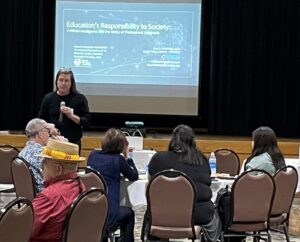
From left: Fred Lane and Dr. Troy Hutchings share their insights at the HEA Leadership Summit and Educator Workshop. Photos by Normita Agustin.
Navigating the Exciting, Disruptive Technology
“HEA sees where generative technology is heading. P-12 educators and other leaders across our islands have an opportunity to learn to navigate this emerging technology,” said HEA President Joan Lewis. “Hawaii educators learned how to harness the benefits of generative technology as well as some of the cautionary ethical issues inherent in generative technology.”
Investing in Hawaii’s Educators
HEA invited two nationally known speakers for the informative sessions, offered at no cost for Hawaii’s educators.
Fred Lane, a nationally recognized expert on privacy and emerging technologies and author of ten books, including “Cybertraps for Educators” and “Cybertraps for the Young,” noted that while most refer to generative technology as artificial intelligence, the world has not yet experienced true artificial intelligence which is created independent of human input and biases.
Preparing for What’s Ahead
Lane said there are positive benefits of generative technology, including improved efficiency, automation, and personalization, but that there are many negatives, including loss of jobs, inaccuracy, loss of privacy, and criminal activity.
For educators, Lane cited potential competition among colleagues, over-reliance on generative technology in preparing and presenting lessons, and inadvertent violation of district or local law and policies as obstacles for the teaching force.
As an attorney, educational consultant, expert witness, and lecturer who has spoken to colleges, universities, and school districts across the country on topics such as student safety, electronic misbehavior, and digital privacy, Lane has a broad perspective and sees the challenges ahead with generative technology. He gave Hawaii’s educators an encouraging forewarning: “Fasten your seat belt, it’s going to be a bumpy ride.”
The other expert speaker, Dr. Troy Hutchings, senior policy advisor for the National Association for the State Directors of Teacher Education and Certification (NASDTEC), is a nationally recognized subject matter expert in educator ethics, focused on the ethics of professional judgment relating to generative technology.
Thought-Provoking Discussions
Dr. Hutchings led valuable group exercises focusing on the projected societal risks of generative technology, and the educator’s responsibility to society to support the greater good.
He posed a thought-provoking question to the group, “What level of risk are we willing to accept?” as they explored scenarios on commonly recognized risks associated with AI, including plagiarism, cheating, privacy and data security issues, unequal access, and over-reliance on AI which could dissuade students from thinking for themselves.
Dr. Hutchings, who has provided expert witness testimony in judicial hearings and has been the subject matter expert on a variety of national projects dealing with educator ethics including the Model Code of Ethics for Educators and the National Council for the Advancement of Educator Ethics, had excellent recommendations for Hawaii’s educators, starting with meaningful conversations on AI and aligning policies and procedures to Hawaii’s existing district policies, relevant federal regulations, and codes of conduct and ethics.
Pearl City High School TAAC Tackles AI
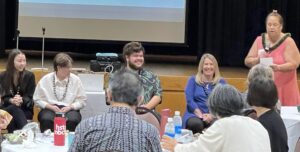
As part of the Educator Workshop, HEA President Joan Lewis welcomed a student panel on AI, featuring Pearl City High School TAAC Club students Kierynn Dixon and RJ Meyers, and Dr. Denise Dugan, Assistant Professor of Education at Chaminade University of Honolulu and teacher candidate Gabe Zapata Berrios.
In addition to the speakers, a stellar panel from Pearl City High School Teaching as a Career Club (TAAC) and an Educator Preparation Program (EPP) faculty and teacher candidate from Chaminade University of Honolulu (CUH) shared their insights into the use of AI in the field.
By Lynn Hammonds, Ed.D.
Program Manager